
The U.S. economy remained resilient in the third quarter, driven largely by strong AI-related business investment. Consumer spending cooled but remained healthy, employment stayed stable, and economic growth exceeded expectations. Inflation remained the primary challenge as rising energy costs tied to the prolonged Iran conflict added pressure. In response, the Federal Reserve (Fed) raised rates by 0.25% in September and signaled a renewed focus on inflation.
Residential Real Estate
Residential real estate remained subdued in the third quarter as higher mortgage rates, rising inventory, and affordability challenges influenced buyer behavior.
Total Existing Sales1 were up 1.6% year-to-date in August, although quarterly sales were slightly down from Q2 and flat year over year. According to the Mortgage Bankers Association (MBA), the new home market was softer, though price cuts, builder incentives, and rising inventory helped support mid-summer purchases. Taken together, these conditions created a market that offered buyers more opportunities than they have had in several years.
August’s existing-home inventory reached a 10-year high, while sellers remained engaged rather than delisting. Abundant inventory, healthy employment, wage growth, and three months of improving affordability2 helped counter significant headwinds. These included the 30-year fixed rate mortgage surpassing 7% in late September, continued quarterly U.S. House Price Index growth of 1.6%, and a shrinking housing starts market as builders faced higher costs from tariffs and labor shortages.
As National Association of REALTORS® Chief Economist Lawrence Yun recently noted, “The ample supply of homes for sale on the market is giving homebuyers better opportunities to negotiate.” For the first time in years, buyers have more choices. Rising inventory, increased negotiating leverage, and seller incentives are easing the competitive conditions that defined much of the past decade.
The chart below illustrates the relationship among affordability, sales, and listings.
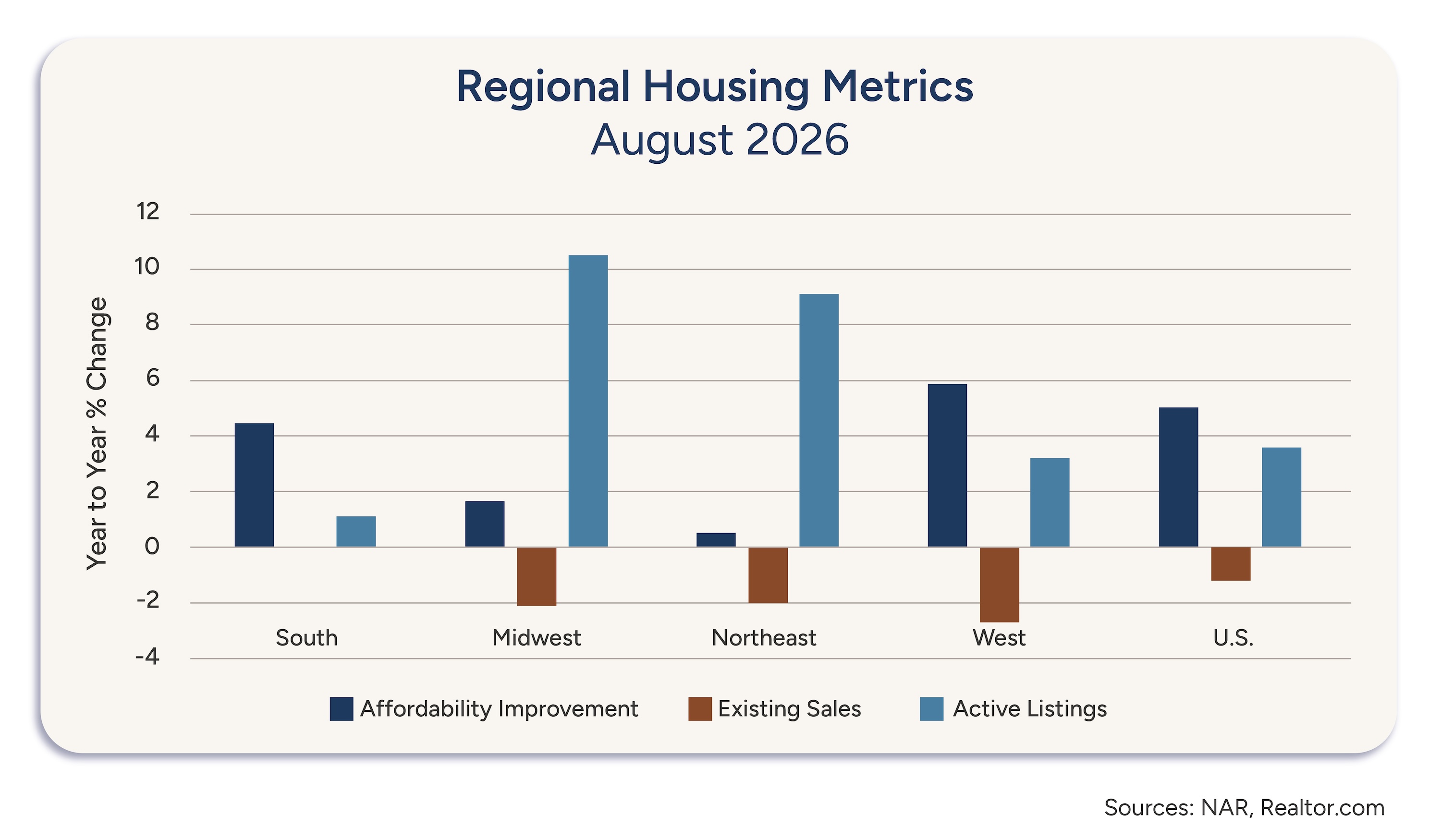
Despite improving affordability, inventory remained relatively limited in parts of the South. The West presented a more complicated picture. Despite improved affordability and rising listings, migration trends and the region’s $629,000 median home price3 may have limited sales growth. In the Northeast and Midwest, active listings increased, but firm pricing continued to temper sales. If listings continue to rise, downward price pressure could become a broader national trend.
Commercial Real Estate
Summer holidays slowed transactions, but CoStar data suggests Q3 commercial real estate (CRE) volume across the four major asset groups exceeded last quarter, reaching roughly $96 billion. Twelve-month growth remained in the low double digits, led by an uptick in industrial activity. A five-month slide in prices supported transaction activity. Office cap rates edged lower this quarter, while other major sectors remained relatively stable.
Even as Treasury yields4 climbed above 5% and the Fed raised rates again, commercial transaction activity remained durable. “An additional 25 basis points by itself is unlikely to fundamentally change a transaction, but a longer period of elevated rates can cause borrowers or buyers on the margins to delay transactions,” one research analyst5 told Bisnow.
Concern remains in the CMBS market6, where delinquencies were elevated and more than half of the loans maturing this year face significant refinancing challenges. Still, overall delinquencies improved in Q2, and distressed transactions were lower than a year earlier. AI-related investment also continued to influence multiple commercial property sectors, particularly industrial, office, and data-center development.
Property Fundamentals by Sector
Recent CoStar reports showed improving fundamentals across the major property sectors.
Multifamily
With fewer multifamily units available in many markets, vacancies fell and rents firmed. The mortgage-to-rent ratio7 boosted apartment demand, partly offsetting weaker household formation and limited immigration.
Retail
Retail remained solid, with limited inventory keeping rental growth near historical rates. Any increase in development was largely absorbed by expanding discounters. The mall subsector also improved. Years of rightsizing have stabilized performance, and some once-struggling malls are proving more resilient than expected.
Industrial
Industrial property still favored tenants as supply continued to outpace demand. The sector remains in transition, with stronger rents and occupancy yet to follow. Some tenants, including geopolitically exposed logistics firms, are stepping back. Others, such as operators of newer large-format facilities built for automation, drove leasing growth.
The AI boom’s ripple effect8 also buoyed the sector: more than 13% of industrial leasing in the first half of the year was AI/data-center related, compared with 14% for all of 2025.
Office
Office’s turnaround was clearest in rents, with August rental growth leading all four major asset groups. New supply remained minimal, while financial firms and AI startups sought space beyond central business districts, following data-center expansion into new submarkets.
Data Centers
Data-center demand did not falter. Since the AI infrastructure boom9 began nearly three years ago, Amazon, Microsoft, Alphabet, and Meta have signed more than $1.5 trillion in data-center leases. While new regulations and ongoing labor and material shortages have slowed expansion, the gigawatt capacity under development10 in North America now exceeds Germany’s total electricity demand.
A Glance Forward
Supported by high-end consumers and AI investment, the Fed projects 2026 economic growth of 2.3%, pointing to a solid final quarter. Employment remains relatively stable. The primary concern remains inflation, which could erode wages and profits. The Fed has indicated that an additional rate increase remains possible this year, with December often cited as the most likely timing. Historically, the Fed has generally avoided making policy changes close to a national election.
In residential real estate, the MBA expects Q4 Existing and New Sales and Starts to rebound from their summer setback as house price growth slips below 1%. Mortgage rates are expected to reach 7% or higher as inflation concerns and Federal Reserve policy continue to influence borrowing costs. However, improving housing inventory may help offset some of those headwinds by creating more opportunities for buyers and supporting market activity.
In commercial real estate, strengthening fundamentals may help offset the challenges of a 10-year Treasury yield above 5%. The traditional year-end uptick in transaction activity could lift volume above the $113 billion recorded in last year's fourth quarter, according to CoStar data, while the Fed's focus on inflation may help stabilize yields and support market confidence. Meanwhile, technology and AI-related investment remain key drivers of economic and CRE growth, helping counter higher rates and inflation. Together, these trends reinforce the resilience that defined the third quarter and could support momentum through year-end.
Sources
1 Copyright ©2026 “NAR Existing-Home Sales Report Shows 2.0% Decrease in August.” NATIONAL ASSOCIATION OF REALTORS®. All rights reserved. Reprinted with permission October 2026. https://www.nar.realtor/newsroom/nar-existing-home-sales-report-shows-2-0-decrease-in-august
2 Copyright ©2026 “National Association of REALTORS: Housing Affordability Index.” NATIONAL ASSOCIATION OF REALTORS®. All rights reserved. Reprinted with permission October 2026. https://www.nar.realtor/sites/default/files/2026-09/hai-08-2026-housing-affordability-index-2026-09-10.pdf
3 Copyright ©2026 “National Association of REALTORS: Existing Single Family Home Sales.” NATIONAL ASSOCIATION OF REALTORS®. All rights reserved. Reprinted with permission October 2026. https://www.nar.realtor/sites/default/files/2026-09/ehs-08-2026-single-family-only-2026-09-10.pdf
4 Board of Governors of the Federal Reserve System (US), Market Yield on U.S. Treasury Securities at 10-Year Constant Maturity, Quoted on an Investment Basis [DGS10], retrieved from FRED, Federal Reserve Bank of St. Louis; https://fred.stlouisfed.org/series/DGS10, October 5, 2026.
5 Bisnow, “First Rate Hike Since 2023 Lands Atop 5% Treasury Yield, Ratcheting Up Capital Pressure.” Reprinted with permission October 2026. https://www.bisnow.com/news/national/capital-markets/62-real-estate-insiders-on-a-year-that-took-a-turn-and-what-theyre-doing-about-it-135235
6 Bisnow, “More CMBS Borrowers Are Slamming Into The $65B Maturity Wall.” Reprinted with permission October 2026. https://www.bisnow.com/news/national/capital-markets/bond-traders-force-cmbs-market-to-reckon-with-rate-reality
7 Avison Young, “U.S. multifamily market report H1 2026.” Reprinted with permission October 2026. https://www.avisonyoung.us/documents/d/us/h1-2026-us-multifamily-report
8 Avison Young, “Data center development drives growing share of U.S. industrial leasing activity.” Reprinted with permission October 2026. https://www.avisonyoung.us/w/data-center-development-drives-growing-share-of-us-industrial-leasing-activity
9 Bisnow, “The Number Of Large-Scale Data Centers In U.S. Projected To Triple By 2030.” Reprinted with permission October 2026. https://www.bisnow.com/news/national/data-center-development/large-scale-us-data-centers-projected-triple-by-2030
10 Bisnow, “Data Center Demand Doubles, Fueling New AI Boomtowns.” Reprinted with permission October 2026. https://www.bisnow.com/news/national/data-center-development/brokerage-data-shows-record-data-center-demand-fueling-new-ai-boomtowns